It is with real regret that one closes Michel Reddé’s fine book on Julius Caesar’s Bellum Gallicum. Elegantly written, clearly structured, and richly illustrated, the study seeks to “confront the victor’s narrative with what archaeology today reveals about the country’s actual condition and the salient episodes of the Bellum Gallicum” (7). This perspective extends the author’s many contributions on the Gallic War[1]. A professeur agrégé de lettres classiques, emeritus university professor, and directeur d’études at the renowned École pratique des Hautes Etudes, Reddé here offers a synthesis of his research.
The book is organized into three major parts: the first presents the political context of the Gallic War; the second describes the lands and peoples involved; and the third, the core of the volume, analyzes the course of the conflict. These parts are framed by a substantial introduction that sets out the topic and by an epilogue devoted to the war’s consequences. For Caesar, who entered “Gaul burdened with debt,” the war ended in considerable enrichment, since “he emerged covered in gold” (263); for Gaul, the author shows that romanization truly took hold only after Caesar, under Octavian Augustus (267). The volume is rounded out by a substantial bibliography, five indexes, and a detailed table of contents.
The first part addresses the war’s political context. The opening chapter relates the conflict’s narrative to the major orientations of Roman politics: Rome’s imperialist project and a political life dominated by the rivalry between Caesar and Pompey. From this perspective, the war appears as a means for Caesar to acquire wealth and advance his ambitions. In his account, however, he mentions neither his personal objectives nor the imperialist dimension of Roman expansion. Thus, when he opposes the migration of the Helvetii, he invokes the dangers to the provincia (BG I, 10, 2) and the memory of earlier Roman defeats (BG I, 13–14), without making his own motives explicit[2]. The chapter closes with useful tables that set events in Rome alongside those in Gaul.
The second chapter considers the literary genre of the Bellum Gallicum. According to the author, it is a war narrative, often biased, as Michel Rambaud (19662) demonstrated, crafted with intelligence and elegance, in which historical facts, concealed political projects, and ethnographic excursuses coexist: Gallia est omnis divisa in partes tres …
The second part examines lands and peoples; its first chapter focuses on the human forces at play. It should be stressed that these numerical estimates remain largely hypothetical, since Caesar’s data are incomplete and sometimes open to doubt.
Demographically, the overall weight of the two camps appears broadly comparable, at around 5,700,000 inhabitants. As for military forces, it is reasonable to assume that they were roughly equivalent during the first two years of the war. Thus, at the battle of the Sambre against the Nervii (BG II 15–28)[3], the proconsul’s army comprised six legions[4], to which allied contingents were added — approximately 40,000 to 50,000 combatants — facing 60,000 Nervii (BG II 28). Thereafter, this balance broke down to Caesar’s disadvantage, owing to losses sustained, the defection of the Aedui, and the formation of larger Gallic coalitions.
The next chapter, devoted to the war’s landscape, underscores the decisive contribution of archaeology, which has profoundly renewed our perception of Gaul in Caesar’s time.
From the middle of the third century BCE, northern Gaul experienced agricultural growth driven by improved tools and favorable climatic conditions, leading to extensive clearing. The landscape was therefore far less wooded than has long been assumed.
In the Bellum Gallicum, settlements are designated by three terms: oppida[5], vici[6], and aedificia[7]. Vicus refers to a medium-sized clustered settlement, whereas the oppidum, expanding rapidly at the end of the second century BCE, corresponds to a large fortified agglomeration such as Bibracte (200 hectares), Avaricum, or the Titelberg. These proto-urban centers fulfilled major political, economic, and religious functions. As for aedificium, the term is polysemous and may denote a large aristocratic residence, a rural estate (villa rustica), or even a simple peasant dwelling.
The next two chapters analyze Gaul’s sociopolitical realities. Gallic nations are generally designated by the rather vague term civitas, referring to a structured political organization. Society is divided into several groups: the plebs, largely devoid of power and portrayed with a certain contempt by Caesar; the druids, who held religious authority, and the equites, whom Caesar presents as military men whose influence rested on the breadth of their client networks. At the summit stood the great men, the principes, such as Orgetorix (BG I 2–4) or Vercingetorix (BG VII 4), characterized by wealth and an extensive clientele. Politically, these societies were governed either by kings (reges), a form of rule then declining, or by aristocratic regimes led by elected magistrates whose power used to be magnified on Gallic coinage. Rivalries among elites, both within and between civitates, were a structuring feature of this political order[8].
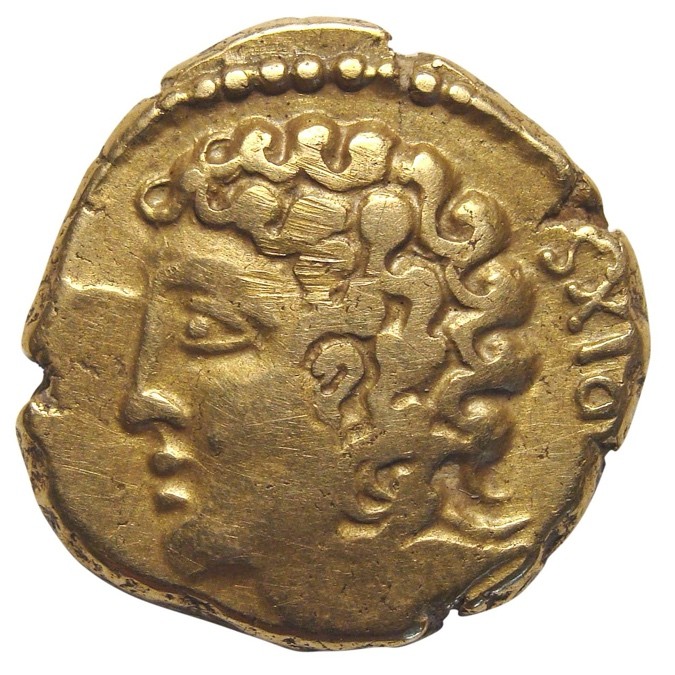

Chapter 5 examines the economic ties between Rome and Gaul, forged well before Caesar’s invasion. Caesar repeatedly mentions Roman mercatores operating in Gaul[9]. Archaeology confirms and refines these relationships, particularly in the wine trade, attested by the many amphorae found across Gallic territory. Long before the conquest, the circulation of Gallic coinage struck on the Roman quinarius standard and bearing on the obverse the head of the goddess Roma — especially among the Aedui — prefigures a kind of Romano-Aeduan monetary union.
The final chapter analyzes the crises that affected Gaul before the Roman invasion: an agricultural crisis triggered by climatic deterioration; a Germanic threat, felt especially in the East, up to the beginning of the Roman intervention[10]; and, finally, a migratory crisis initiated by the Helvetii, who wished to settle in the Saintonge region. This episode provided Caesar with the pretext for his intervention in Gaul, since he could invoke the dangers that this migration posed to the provincia[11].
The third part, the most extensive section of the volume (132 pages), is devoted to the various dimensions of the military operations.
The first chapter addresses the war’s chronology and geography. The author has wisely chosen to handle these two themes through chronological tables complemented by maps detailing operations on the ground. The accompanying commentary highlights, in particular, the seasonality of the campaigns and the differentiated geography of a conflict that affected Gallic peoples very unevenly.
The next chapter is devoted to Caesarean logistics. Faithful to his method, the author cross-references textual sources and archaeological data. Caesar’s supply system relied first and foremost on his Gallic allies, especially the Aedui. It was supplemented by raids and pillaging, which struck populations already weakened by the agricultural crisis and the war, as well as by purchases made locally through Roman intermediaries and via the network of Italian merchants established in the major oppida, including, inter alia, the Titelberg-oppidum. Cereals, above all wheat and barley, formed the basis of the legionary’s diet, sometimes supplemented by local cured-meat preparations. Mediterranean products—wine, oil, and fish sauces—seem, by contrast, to have been reserved for officers.
In the chapter entitled “Weaponry and Combat Norms,” the author first examines the artifacts uncovered at four major military sites: Alesia, Uxellodunum, Hermeskeil, and Gergovia. He notes that these excavations enabled Professor Poux to reconstruct the legionary’s panoply (173–174). He also points to the use of various forms of artillery, especially ballistae. Analysis of combat practices, based largely on the texts, proves more delicate. Battle generally began with a volley of pila, followed by a hand-to-hand charge. The author stresses, however, that the Bellum Gallicum offers little basis for going much further. By contrast, Roman military superiority clearly rested on iron discipline and on unit cohesion in maneuvering[12]. The chapter closes with a few remarks on Gallic and Germanic combat practices and on the tactical importance of cavalry.
The next two chapters provide an inventory of the archaeological sites in the BG. The first gather sites other than the major sieges: the battle of the Aisne in 57 (BG II 8–11), the expedition across the Rhine (BG IV 16–19), and the massacre of the Usipetes and Tencteri (BG IV 4–15)[13] at Kessel-Lith, recently studied by Nico Roymans[14], inter alia.
The second, more developed, is devoted to the conflict’s major sieges of 52–51: Avaricum, the siege of the massacre (BG VII 16–28); Gergovia, the assault-siege (expugnatio) ending in a Roman defeat (BG VII, 34–36; 41, 43; 44–53)[15]; Alesia, the great blockade-siege (obsessio) leading to Caesar’s final victory (BG VII 68–89) and Uxellodunum (BG VIII 32–44). The discussion of the Hermeskeil camp, which played a role in the campaigns against the Treveri (BG VI 7 and VIII 25 and 45), concludes the chapter. Faithful to his method, Michel Reddé grounds his analysis at once in Greco-Roman poliorcetic treatises[16], Caesar’s testimony, and archaeological data.
The most extensive and most compelling section is undoubtedly the one devoted to the obsessio of Alesia, which the author knows firsthand, having directed the Franco-German excavations at the site[17]. Here we see Caesar deploy, with complete mastery, the classic procedures of siege warfare: construction of castra and castella, encirclement of the oppidum by lines of circumvallation and contravallation, methodical organization of the blockade, and so forth. Whenever possible, the analysis is accompanied by particularly rich explanatory illustrations.
The final chapter is devoted to Vercingetorix, one of the emblematic figures of the French national narrative. Despite the many references to Vercingetorix in Caesar’s account, Reddé argues that the available sources do not allow for an objective portrait of the initiator of the great Gallic revolt against Rome.
As suggested from the outset, Professor Reddé has written an excellent book. One regret may, however, be allowed : the author addresses only very briefly the issue of the massacres perpetrated by Caesar’s army in Gaul[18]. He might have integrated it into the passage devoted to the massacre of the Usipetes and Tencteri, studied by the Dutch archaeologist Nico Roymans.
That said, one should above all emphasize how successfully the author paints a portrait of Gaul at the time of Caesar’s conquest, combining, as far as possible, the philological and historical study of the Caesarean text with the material evidence provided by archaeology[19].
Caesar’s text is of interest in multiple respects. It is not only a work of high literary qualitybut also a text that through the questions it raises — imperialism, war, wartime violence, political machinations, Caesarean authoritarianism — retains an unmistakable political relevance.
Michel Reddé’s book will now offer specialists and the wider public alike an excellent guide to approaching this major text with discernment.
An abstract in French, the original language of the book, has been added to this review.
Michel Reddé propose, dans La Gaule devant César, une réévaluation du Bellum Gallicum fondée sur un dialogue constant entre le texte césarien et les acquis récents de l’archéologie. L’ouvrage, de facture synthétique et richement illustré, s’articule en trois ensembles complémentaires. Une première partie restitue les déterminants politiques de la conquête, en soulignant l’inscription de la guerre dans l’expansion romaine et dans la concurrence César–Pompée, ainsi que les implicites rhétoriques d’un récit tendant à occulter les finalités personnelles du proconsul. La deuxième partie dresse un tableau des cadres territoriaux et humains : hiérarchies sociales, types de gouvernement, formes de l’habitat ( oppida, vici et aedificia) et intensité des échanges économiques antérieurs à 58, notamment attestés par les circulations monétaires et amphoriques. La troisième partie, la plus développée, traite des opérations militaires, avec une attention particulière à la chronologie, à la géographie et aux contraintes logistiques ; y sont examinés l’armement, les tactiques militaires et les dispositifs de siège, à partir de dossiers archéologiques majeurs (Alésia, Uxellodunum, Gergovie, Hermeskeil). L’analyse d’Alésia, nourrie par l’expérience de terrain de l’auteur, met en évidence la cohérence des aménagements de circonvallation et de contrevallation et leur inscription dans une tradition poliorcétique gréco-romaine. En conclusion, Reddé rappelle l’ampleur de l’enrichissement césarien et situe la romanisation principalement dans le cadre augustéen. On pourra toutefois noter que la question des violences de guerre, en particulier les massacres, n’est abordée qu’incidemment. L’ensemble constitue une mise au point fort utile et solidement étayée.
Bibliography and Web Resources
Barrandon, Nathalie. 2018. Les massacres de la République romaine. Paris : Fayard.
Caesar, Julius & Aulus Hirtius. 2017. The Landmark Julius Caesar : The Complete Works : Gallic War, Civil War, Alexandrian War, African War, and Spanish War … . K. A. Raaflaub and R. B. Strassler, (eds). New York : Pantheon Books.
Caesar, Julius. 19261/202314. Guerre des Gaules. Texte établi et traduit par L.-A. Constans,14th édition revue et corrigée par A. Balland. Paris : Les Belles Lettres.
DNP = Cancik, Hubert, Helmut Schneider, Brigitte Egger, Jochen Derlien & alii (Hrsg.). 1996–2010. Der Neue Pauly. Enzyklopädie der Antike. 16 Bände. Stuttgart/Weimar : Metzler.
Dumoulin, François. 2026. Review of Reddé, La Gaule devant César. Revue archéologique du centre de la France 65, 4b–5b.
Goldsworthy, Adrian Keith. 1996/2009. The Roman Army at War 100 BC –200 AD. Oxford : OUP.
Hulot, Sophie. 2018. César génocidaire ? Le massacre des Usipètes et des Tenctères (55 av. J.-C.). Revue des Études Anciennes 120/1, 73–99. doi : https://doi.org/10.3406/rea.2018.6869
Kiernan, Ben, Tracy M. Lemos, and Tristan S. Taylor (eds). 2023. The Cambridge World History of Genocide I : Genocide in the Ancient, Medieval, and Premodern Worlds. Cambridge : CUP.
Krebs = Caesar, J. (2023). Bellum gallicum. Book VII. Ed. Christopher B. Krebs. Cambridge : CUP.
Pollard, Nigel & Berry, Joanne. 2015/2020. The Complete Roman Legions. London : Thames and Hudson.
Rambaud, Michel. 19662. L’Art de la déformation historique dans les ‘Commentaires’ de César. Paris : Les Belles Lettres.
Reddé Michel & Siegmar von Schnurbein (éds). 2001. Alésia. Fouilles et recherches franco-allemandes sur les travaux militaires romains autour du Mont-Auxois (1991–1997). Mémoires de l’Académie des inscriptions et b elles-Lettres, vol. 22. Paris : De Boccard.
Roymans, Nico. 2018. A Roman Massacre in the Far North : Caesar’s Annihilation of the Tencteri and Usipetes in the Dutch River Area. In Conflict Archaeology: Materialities of Collective Violence from Prehistory to Late Antiquity, edited by Manuel Fernández-Götz and Nico Roymans, 167–181. Abingdon/New York : Routledge.
Taylor, Tristan S. 2024. A Cultural History of Genocide in the Ancient World. London/New York/Oxford/New Delhi/Sydney : Bloomsbury Academic.
Verger, Stéphane. 2009. Société, politique et religion en Gaule avant la Conquête. Pallas. Revue d’études antiques 80, 61–82. doi : https://doi.org/10.4000/pallas.1760
Notes
[1] See the bio-bibliographical notice on ANHIMA.
[2] See footnote 1 on p. 12 in the Constans/Balland edition.
[3] On this battle, see Raaflaub/Strassler (2017, 62–74).
[4] On the Roman legions, see Goldsworthy (1996/2009, 33–37), and Pollard/Berry (2015/2020, 24–26).
[5] On oppidum, see the excellent article by V. Pingel in DNP 8, cols. 1261–1264.
[6] On vicus, see DNP 12/2, col. 193.
[7] Cf. BG I 5, 2: … oppida sua omnia, numero ad duodecim, vicos ad quadringentos, reliqua privata aedificia incendunt … .
[8] For an anthropological analysis of Celtic power structures, see Verger (2009).
[9] Cf. BG VII, 3, 1; Krebs (2023, 124); Raaflaub/Strassler (2017, 204).
[10] BG I, 30–54.
[11] Cf. BG I, 2–29.
[12] Cf. Caesar’s speech after the defeat at Gergovia, BG VII, 52.
[13] Cf. Hulot (2018).
[14] Cf. Roymans (2018).
[15] On the siege of Gergovia, see Choitz (2011, 135–155).
[16] On Greco-Roman siegecraft, see DNP 10, cols. 16–21.
[17] Cf. Reddé/von Schnurbein (2001).
[18] On this topic, see, for example, Kiernan (2023), Taylor (2024), and Barrandon (2018).
[19] The contrary view defended in F. Dumoulin’s review (2026, 5a–b) is difficult to sustain.